
| Types of Rock | | | Properties | | | Volcanoes | | | Articles |
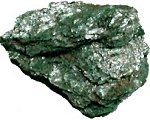
Fuchsite
| Chemical Composition: K2(Al,Cr)4Si6Al2O20(OH,F)4 | |
| Group: Mica |
Hardness: 2-2.5 |
| Colour: Green | Streak: white |
Density: 2.77-2.88 |
Luster: vitreous |
Cleavage: Perfect basal cleavage |
Fuchsite is a complex hydrous potassium-aluminum silicate which belongs to the mica group of minerals. It has a beautiful green colour which is caused by a chromium impurity. Because it is the chromium which is responsible for the colour of the stone, the degree of green will vary according to the amount of the impurity. In specimens where the fuchsite has small crystals, these give a distinctive sparkly shine to the surface of the stone.
Mica is subdivided into into two major subgroups: dark mica, which is rich in both iron (Fe) and magnesium (Mg); and white mica which is rich in aluminium. In addition there is a series of lithium micas. In all, there are more than 20 chemically distinct mica species with considerable variance in geological occurrence, but all have essentially the same crystal structure. Micas crystallize with a sheet structure, the sheets being held together by relatively weak bonds resulting in perfect basal cleavage (that is, thin sheets of crystals held loosely together).
Biotite, which is the most common of micas, is an example of a dark mica containing iron and/or magnesium impurities which have substituted some of the octahedral aluminum. Muscovite is a pure potassium mica, containing no impurities. It is a classic example of a white mica. Fuchsite is actually a variety of muscovite. It has the same chemical structure apart from the fact that some of the octahedral aluminium in the muscovite crystal structure has been replaced by chromium.
Fuchsite is widely distributed. It can be found in in shist, dolomites and basical rocks. It is also frequently found as part of peridotites (Periodites are any of a group of igneous rocks composed mainly of olivine and various pyroxenes and having a granitelike texture) and as part of serpentinites (Serpentine is a group of common rock-forming hydrous magnesium iron phyllosilicate).
Unusual corundum-fuchsite rocks with Al2O3 content of up to 89 per cent and Cr2O3 values of up to 2.8 per cent have been found in Zimbabwe and the Transvaal. They form lenses within volcano-sedimentary rocks containing different metamorphic grades.
 |
| Rocks in Focus |
© Biscuit Software 2016