
| Types of Rock | | | Properties | | | Volcanoes | | | Articles |
Andalusite
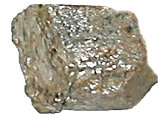
| Chemical Composition: Al2SiO5 | |
| Group: silicate |
Hardness: 6.5-7.5 |
| Colours: dark green, grey, brown, red, green | Streak: white |
Density: 3.1-3.2 |
Luster: vitreous |
Cleavage: distinct in one direction |
Andalusite is an anhydrous aluminosilicate mineral Al2SiO5. It was first found in Andalusia in Spain, which is why it has its name, though it is actually a relatively common mineral widely distributed in many countries including France, Austia, Germany, USA South Africa, Australia and Brazil.
Andalusite shares its chemical structure with two other minerals, namely kyanite and sillimanite. These three minerals are called polymorphs, because although their chemical structure is the same, their crystal structures are different. A unique variety of andalusite is called 'chiastolite'.
This contains black or brown clay and/or carbonaceous material inclusions in the crystal. These inclusions are arranged in regular symmetrical shapes usually in the form of a cross or X. Andalusite is found predominantly in sedimentary rocks where it is associated with kyanite, sillimanite, cordierite, corundum, garnet, tourmaline and mica. Chiastolite is common in some metamorphic rocks. Water-worn pebbles of gem quality are found at Minas Gerais, Brazil.
After calcining (a thermal treatment process in which ores and other solid materials undergo thermal decomposition, phase transition, or removal of a volatile fraction) at high temperatures Andalusite is converted into mullite 3Al2O3·2SiO2 and silica.
These are refractory materials (stable at high temperature) and are therefore used in the production of furnaces, boilers, ladles, and kilns, in metallurgy, and among others, in the glass, chemical, and cement industries. One metric ton of mineral concentrate following calcining yields about 0.88 t of mullite.
Andalusite is infusible and insoluble, but the powder is slightly coloured blue when fire is applied to it after it has been moistened with cobalt nitrate (the aluminum test).
 |
| Rocks in Focus |
© Biscuit Software 2016