|
In focus: Ulexite |
| Chemical Composition: NaCaB5O9.8H2O | |
| Group: Borate | |
| Colour: Colorless, White | |
| Streak: white | |
| Hardness: 2.5 | |
| Density: 1.9-2 | |
| Luster: Chatoyant | |
| Cleavage: Perfect |
|
Ulexite (hydrated sodium calcium borate hydroxide) is a complex mineral, which was discovered in the 19th century and was named after the discoverer; a German chemist named G. L. Ulex. Ulexite is relatively insoluble in water but will decompose in hot water. It is very soft (it can be scratched by a finger nail) and has low density. |
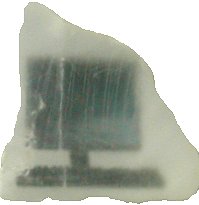
Ulexite is composed of long sodium chains which are linked together by water, calcium hydroxide and oxygen polyhedra (a polyhedron is a three - dimensional figure made up of sides called faces, each face being a polygon ) and negatively charged boron molecules (B5O6(OH)6). One of the distinguishing feature of Ulexite is its unusual optical properties. When a slice of Ulexite is polished on both sides it will display an image of whatever surface is adjacent to its other side. This is why Ulexite is also referred to (or even better known as) “ TV rock ”. Although the optical properties have been known for a long time, it was Bob Potter who, in 1963, recognized the fibrous properties of the stone which could explain the unusual optics.
So what happens to the light passing through Ulexite? In a very simple terms, as the light passes through the rock, the fibers act as fiber optics, transmitting light along their lengths by internal reflection. To find out more about fiber optics try the “City of Light: The Story of Fiber Optics” by Jeff Hecht.
The major deposits of Ulexite are in California and Nevada, USA; the Tarapaca Region in Chile, and in Kazakhstan. Ulexite is associated with borax deposits and is commonly found on the bottom of intermittent lakes (playas); water evaporation being the key trigger in the formation of deposits. It playas, Ulexite forms into “cotton ball” like structures. Ulexite can also be found along the veins of borax where it compacts into closely-packed fibrous crystals.
Identification of Ulexite is relatively easy because of its characteristic optical properties. Other identifying features are:
| _______________________________ | ||||
| Home | | | Shopping | | | Database |
© Biscuit Software 2004-2015
All rights reserved