|
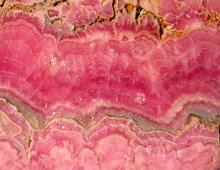
In focus: Rhodochrosite |
| Chemical Composition: MnCO3 | |
| Group: Carbonate | |
| Colour: Pinkish red, Red, Rose red, Yellowish gray, Brown | |
| Streak: white | |
| Hardness: 3.5-4.5 | |
| Density: 3.4-3.7 | |
| Luster: Vitreous | |
| Cleavage: Perfect |
|
Rhodochrosite is a manganese carbonate mineral with the chemical composition MnCO3. In its pure form, Rhodochrosite is typically a rose-red colour, but impure specimens can be shades of pink to pale brown. Its name is derived from the Greek word for 'rose-colored' (rhodom - 'rose' and chrosis - 'colouring'). The pink colour of Rhodochrosite is caused by the element manganese and it is formed when manganese is dissolved by ground water and combines with a carbonate material. |
Rhodochrosite belongs to the trigonal crystal system. Crystal habits include the rhombohedrons and scalahedrons with rounded or curved faces that can obscure the crystal shape. Some crystals can be flattened to a bladed habit and these are sometimes aggregated into rosettes or minute crystals into spherules.
Rhodochrosite commonly forms during oxidation of Mn-bearing ores in a carbonate environment and occurs as a large rock mass. It can also form as a hydrothermal vein mineral along with other manganese minerals in low temperature ore deposits. Indeed, it was in a hydrothermal vein where Rhodochrosite was first discovered in a silver mine in Romania in 1813. Rhodochrosite crystals are rare. The best specimens have been found in the Sweet Home Mine near Alma, Colorado. Folks in Colorado are very proud of this fact and on April 17, 2002 Rhodochrosite was approved as the official state mineral of Colorado.
Rhodochrosite occurs in many locations around the world including: the United States, South Africa, Argentina, Peru, Mexico, Romania, Spain, France, Russia, Germany and Italy
The identification of Rhodochrosite is relatively easy. The three major identification tests are as follows:
| _______________________________ | ||||
| Home | | | Shopping | | | Database |
© Biscuit Software 2004-2015
All rights reserved